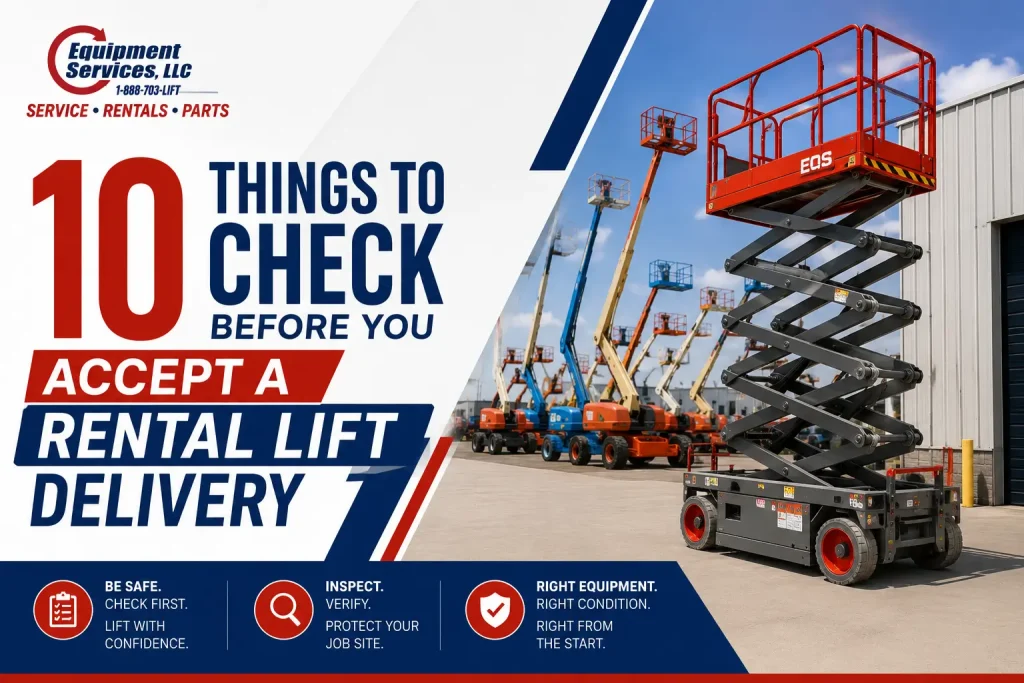
10 Things to Check Before You Accept a Rental Lift Delivery
- Daniel Hagerman
- August 18, 2026
- 11:44 am
1. Check the Machine for Visible Damage
Walk the full perimeter before anything else. Look for:
- Bent guardrails
- Cracked welds
- Hydraulic leaks or wet spots under the machine
- Damaged or worn tires
- Broken lights or mirrors
- Missing or illegible safety decals
Not everything you find here is a dealbreaker, and it helps to know the difference. A weld crack you can see daylight through, or one that runs along a stress point rather than a surface scratch, is a structural issue and grounds to refuse the machine. A scuffed paint mark or a bent, non-structural guard panel is cosmetic and usually fine to note and move on from. When in doubt, photograph it and ask the driver directly whether it’s something their shop already logged. Damage that shows up after delivery is easy to argue about. Damage you catch and document before signing isn’t your problem to explain later.
2. Confirm You Received the Correct Model
This sounds obvious, but mismatched deliveries happen more than most renters expect, especially when a supplier is juggling multiple orders on the same route. Check:
- Model number, matched against your rental agreement
- Working height, not just platform height
- Platform capacity
- Power source, electric, diesel, or dual fuel
- Indoor-rated vs rough terrain version
Getting this wrong doesn’t just waste time. If the wrong model reaches your work area and can’t do the job, you’ve lost a day waiting on an exchange. If you’re still working out which size or type fits your project, our scissor lift sizing guide and boom lift rental cost breakdown cover how to match equipment to the job before you book.
3. Inspect Tires and Wheels
Tires take a beating in transport and storage, so check them specifically:
- Cuts or gouges in the tread
- Uneven wear, which can signal an alignment or suspension issue
- Loose wheel nuts
- Proper inflation on pneumatic tires
A shallow surface cut that doesn’t reach the tire’s internal cording is generally fine to work with for a short rental. A cut deep enough that you can see cording or belt material, or a tire that’s visibly under-inflated on one side compared to the others, is worth flagging before you sign, since either can turn into a flat mid-job on uneven ground. A tire issue caught at delivery is a quick fix for the driver. The same issue discovered mid-job means downtime while you wait for a service call.
4. Test Every Control
Never assume the controls work just because the machine looks fine. Test each one with the delivery driver present:
- Raise and lower
- Emergency stop
- Drive
- Steering
- Horn
- Platform controls
- Ground controls
- Emergency lowering system
If anything hesitates, sticks, or doesn’t respond the way it should, that’s the moment to flag it, not after the driver has already left.
5. Check Safety Equipment
Safety systems are non-negotiable, and they’re also easy to overlook in a quick visual scan. Confirm:
- Emergency stop function
- Harness anchor points, present and undamaged
- Guardrails secure and undamaged
- Entry gate closes and latches properly
- Audible alarm functions
- Tilt sensor, where equipped
- Load sensor, where equipped
Any one of these missing or malfunctioning is a reason to hold off on signing until it’s resolved. If your crew needs a refresher on what proper fall protection looks like on a boom lift specifically, our OSHA aerial lift requirements guide covers harness and anchor point rules in detail.
6. Review Inspection and Maintenance Records
Ask the driver for documentation, not just a verbal assurance that the machine is fine. Request:
- Pre-delivery inspection record
- Recent maintenance history
- Annual inspection documentation
- ANSI A92 inspection compliance, where applicable
- OSHA-related compliance records, if your job site requires them
A rental company confident in its fleet condition will have this paperwork ready without hesitation. If it takes real effort to produce, that’s worth noting.
7. Check Fuel or Battery Condition
What you’re checking depends on the power source:
Diesel units
- Fuel level
- DEF level, if the machine requires it
Electric units
- Battery charge level
- Charging cable included and undamaged
- Overall battery condition, especially on older units
Starting a job with a half-charged battery or a near-empty tank costs you working time you’re still paying rental rates for.
8. Make Sure Manuals Are Included
Check that the machine comes with:
- Operator manual
- Safety decals, present and legible on the machine itself
- Emergency instructions
- Load chart, specifically for telehandlers
Missing documentation isn’t just an inconvenience. If an inspector or safety officer asks for it on site, “the rental company forgot to include it” isn’t a great answer to have.
9. Walk Around the Job Site
The machine could be in perfect condition but still the wrong fit for where it’s going. This action is the most commonly overlooked on this list and is one of the most time consuming if not the most time consuming of the list. Check:
- Ground condition where the lift will operate
- Overhead power lines near the work area
- Slopes across the site
- Door widths, if the lift needs to move indoors
- Obstacles between the delivery point and the actual work area
A perfectly good lift that can’t reach the work zone because of a doorway or a slope wastes just as much time as a damaged one.
10. Report Problems Before Signing
If anything on this list raises a concern, deal with it before the driver leaves:
- Take photos of any damage or concerns, timestamped if your phone supports it
- Tell the driver directly, don't wait to call the office later
- Document everything in writing, even a quick note on the delivery receipt
- Request a replacement machine if the issue is serious enough to affect the job
Once you sign, you’ve generally accepted the equipment as delivered. A few extra minutes here saves a much longer argument afterward.
Delivery Inspection vs Daily Pre-Use Inspection
Equipment-Specific Inspection Points
1. Boom Lifts:
- Harness anchor point present, undamaged, and rated for the platform. Boom lift operators are required to stay tied off at all times while elevated, so a missing or compromised anchor point isn't a minor gap, it's the entire fall protection system for the machine.
- Full range of motion, articulation joints included, checked for unusual noise or resistance. A boom that hesitates or grinds partway through its range often signals a hydraulic or joint issue that gets worse under load, not better.
- Outriggers or stabilizers inspected for damage or hydraulic leaks, where equipped. These are what keep the machine from tipping at extended reach. A leak here is a stability problem waiting to happen, not just a maintenance note.
- Tilt and load sensors respond correctly during testing. These sensors are what stop the machine from operating outside safe limits. If they don't trigger during a test, the boom has no way of warning you before it's already in a dangerous position.
2. Scissor Lifts:
- Scissor arm mechanism checked for visible wear, cracks, or misalignment. This is the entire lifting structure. Wear here isn't cosmetic, it's the mechanical system that has to hold the platform level under load.
- Guardrails secure on all sides. Scissor lifts rely on guardrails rather than a harness for fall protection, which means a loose or damaged guardrail is a direct substitute failure for what a harness would catch on a boom lift.
- Entry gate or chain closes and latches properly. An open or non-latching gate defeats the guardrail system at exactly the point workers step on and off the platform.
- Platform extends and retracts smoothly, if the model has a slide-out deck. A deck that binds partway out can shift weight unevenly across the platform while it's elevated.
3. Telehandlers:
- Forks or attachment checked for cracks, bends, or excessive wear. A bent fork changes how a load actually sits and balances, which affects the machine's stability in ways that aren't obvious just from looking at the load itself.
- Load chart present in the cab and matching the attachment installed. The rated capacity changes based on boom extension and attachment type. Operating off the wrong chart, or no chart at all, means guessing at a limit that's supposed to be exact.
- Boom extension and retraction checked for smooth operation without unusual noise. Telehandlers move heavy, often unevenly distributed loads at extension, so any hesitation in the boom itself is a bigger risk here than on lighter equipment.
- Stabilizer legs, where equipped, checked for full extension and secure locking. These are what keep the machine planted while lifting at reach. A leg that doesn't fully lock is a tip-over risk under load.
Red Flags That Mean You Should Refuse Delivery
- A hydraulic leak
- A broken or bent guardrail
- An emergency stop that doesn't function
- The wrong model delivered
- An expired inspection sticker
- Visible structural damage, cracks, or bent frame components
- Missing operator manuals or required safety documentation
Questions to Ask the Rental Company
- When was this machine last serviced?
- Has it passed its most recent inspection?
- Who do I call if it breaks down on site?
- Is roadside or on-site support available if something fails?
- Can this rental be exchanged quickly if there's a problem?
Printable Delivery Checklist
- Walked full perimeter, checked for visible damage
- Confirmed model number, working height, and power source match the order
- Inspected tires and wheels
- Tested raise, lower, drive, steering, and horn
- Tested emergency stop and emergency lowering
- Checked guardrails, entry gate, and harness anchor points
- Confirmed tilt and load sensors respond correctly
- Reviewed pre-delivery inspection and maintenance records
- Checked fuel level or battery charge
- Confirmed operator manual, decals, and load chart (if applicable) are present
- Walked the job site for ground conditions, power lines, and doorway clearance
- Took photos of the machine's condition before signing
- Reported any issues to the driver directly, in writing
Not sure which lift fits your site? Our team will match the machine to the job before you rent.
Frequently Asked Questions

About Daniel Hagerman
Daniel Hagerman writes about equipment rentals, machine selection, and rental costs for EQS LLC, including the Rental guides.